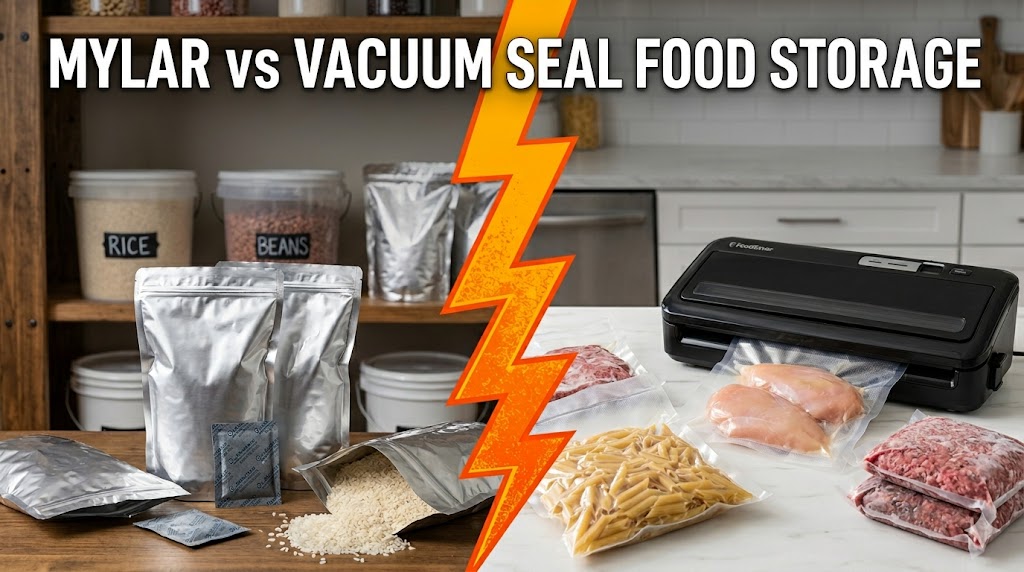
If you are buying food in bulk to protect your family from rising prices or supply chain surprises, you’ve probably hit a crossroads. You know you can’t just leave 20 pounds of rice or oats in their original cardboard or flimsy plastic grocery bags. Pests, humidity, and oxygen will ruin your investment before your family ever gets a chance to eat it.
So, how do you lock out the elements?
The two most popular tools in the prepping community are Vacuum Sealers (like a FoodSaver) and Mylar Bags with Oxygen Absorbers.
Both methods are fantastic, but they serve completely different purposes. If you use the wrong one for the wrong job, you’ll end up wasting money on spoiled food. Let’s break down exactly which one your family needs, when to use them, and the exact gear to look for.
The TL;DR Winner’s Box
Don’t want to read a massive comparison? Here is the golden rule for family food storage:
- Choose a Vacuum Sealer if: You are preserving meats for the freezer, or stocking foods in your “Working Pantry” that your family will open and eat within the next 1 to 2 years (like bulk snacks, cereal, or baking staples).
- Choose Mylar Bags if: You are building a “Deep Cache” of dry staples (rice, beans, oats, pasta) meant to sit untouched for 5 to 25 years as emergency insurance.
The Showdown: How They Compare
To keep a household running smoothly, we look at storage solutions through a very practical lens: cost, lifespan, and physical durability against pests (or curious kids).
| Feature | Vacuum Seal Bags | Mylar Bags + O2 Absorbers |
|---|---|---|
| Best For | Freezer storage & 1–2 year dry rotation | 5–25 year long-term emergency preservation |
| Material | Clear, flexible polyethylene plastic | Thick, metallic aluminum foil laminate |
| Light Protection | None (Clear bags let light degrade food) | 100% Light block (Crucial for nutrients) |
| Oxygen Barrier | Fair (Plastic pores microscopically leak over years) | Absolute (Zero oxygen transmission) |
| Pest Protection | Low (Mice can easily chew through plastic) | High (Even higher when paired with a bucket) |
1. Vacuum Sealing: The Working Pantry Champion
A clear vacuum sealer machine is an absolute workhorse for a busy family kitchen. It works by physically sucking the air out of a textured plastic bag and melting the edge closed with a heated seal bar.
The Pros:
- The Freezer Savior: It prevents freezer burn entirely. You can buy meat in bulk when it’s on sale, portion it out for your family’s meal sizes, and keep it fresh in the freezer for years.
- Resealing Everyday Items: If your kids leave a giant bag of chips or cereal open, you can use your sealer to pop a quick heat seal on the original bag to stop it from going stale.
The Cons:
- Microscopic Air Leakage: Standard plastic vacuum bags are slightly porous. Over 3 to 5 years, tiny amounts of oxygen will leak back through the plastic, degrading dry goods.
- Zero Light Protection: Light destroys nutrients over time. Because these bags are clear, you have to store them in a dark closet or box.
Our Recommended Setup:
For a busy household, you don’t need a massive commercial unit. A compact, reliable upright machine saves counter space and handles bulk grocery hauls easily.
- The Machine: The FoodSaver VS0150 PowerVac Compact Vacuum Sealer is perfect for regular family use. It seals tightly, has a dedicated wet/dry setting for meats vs. dry staples, and features a slim profile.
- The Bags: Skip the expensive name brands for daily storage and use heavy-duty Commercial Grade Vacuum Sealer Rolls. Rolls allow you to cut custom sizes, which is essential when portioning out bulk family packs of chicken or ground beef.
2. Mylar Bags: The Deep Cache Insurance Policy
Mylar looks like shiny metal foil, but it’s actually an advanced multi-layered laminate that forms an impenetrable wall against light, moisture, and oxygen.
You don’t use a vacuum machine for these; instead, you drop an Oxygen Absorber inside the bag and seal the top edge flat with a standard household hair straightener or clothes iron.
The Pros:
- True Long-Term Shelf Life: When you combine a thick Mylar bag with an oxygen absorber, the oxygen level drops to 0.01%. This keeps white rice, pinto beans, and pasta fresh for up to 25 to 30 years.
- Nutrient Retention: Because it blocks 100% of light, food doesn’t discolor or lose its vitamin content over decades.
The Cons:
- Not for Freezers: Mylar gets brittle when frozen and can develop tiny pinhole cracks. Keep it in the pantry or room-temperature storage.
- Not for Frequently Used Foods: Once you cut a Mylar bag open, the vacuum seal is broken, and you have to use a new oxygen absorber to reseal it. It is strictly for long-term storage.
Our Recommended Setup:
When buying Mylar, thickness matters. Avoid cheap 3-mil bags that puncture easily on sharp pasta edges. Stick to 5-mil or 7-mil thickness and ensure the oxygen absorbers are included in a sealed pack.
- The Complete System: The Wallaby 1-Gallon Mylar Bags and 400cc Oxygen Absorbers Set is the industry standard for family preppers. One-gallon bags are highly manageable—they hold about 7 pounds of rice or beans each, making them easy to carry and perfect for a family-sized meal base.
- The Rodent Defense: Mice can chew through Mylar if left completely exposed on a shelf. Always place your filled Mylar bags inside a standard Hudson Exchange 5-Gallon Food-Grade Bucket with a lid. This setup gives you a waterproof, pest-proof, and child-proof fortress pantry.
The Verdict: How to Combine Both for Ultimate Peace of Mind
To build a true “one-stop” family pantry, you should actually use a hybrid system.
- Use your FoodSaver Vacuum Sealer for your freezer rotation (beef, chicken, frozen veggies) and your short-term dry storage (baking flour, brown rice, snacks, and cereal that you rotate through every few months).
- Use your 1-Gallon Mylar Bags inside 5-gallon buckets to lock away your emergency insurance supply of white rice, hard grains, rolled oats, and dried beans that you don’t intend to touch unless a true emergency hits.
By splitting your pantry into a Working Loop (Vacuum Seal) and a Deep Guard (Mylar), you protect your wallet from inflation today while ensuring your kids are secure for the next twenty years.
Which system are you using to build your food cache right now? Let us know in the comments below!